

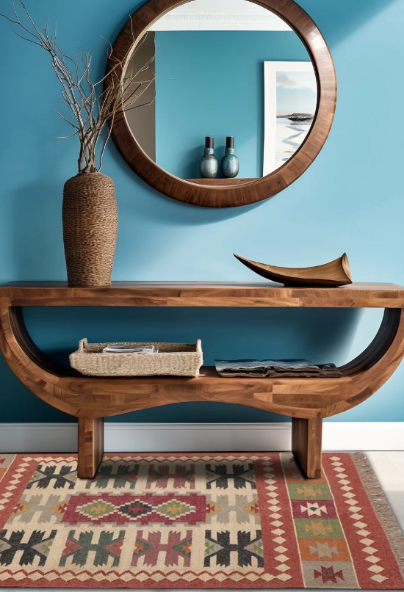
An entrance is asked to do several jobs before anyone reaches the living room. It receives footwear, accommodates deliveries, connects the outside world to the home and, in many Indian households, marks the point where shoes are removed. Yet it is often treated as leftover floor space rather than a part of the home’s design.
A handmade jute mat can give this threshold a more deliberate arrangement. Its appeal lies in the visible texture of the fibre and the character of its weave. But placement matters. Jute is not a substitute for a heavy-duty outdoor scraper mat, particularly where wet footwear and rainwater are involved.
The Indian Entrance Is a Working Space, Not Just a First Impression
Consider a typical city apartment. The main door may open directly into a living area, with a shoe cabinet against one wall and very little space between the door swing and the furniture. A mat that is too wide can obstruct the door or make the entrance feel cramped.
In a larger independent home, the arrangement may be different. There could be a covered porch, a foyer or a verandah before the main living space. This creates an opportunity to separate the outdoor footwear zone from the cleaner indoor threshold.
These layouts call for different solutions. A mat should be measured against the door opening, available floor width, and the space needed to remove footwear. Choosing one simply because it looks attractive in a product photograph misses the practical job it has to perform.
Where Does a Jute Mat Actually Work Best?
Jute is a plant-based bast fibre known for its characteristic coarse texture and natural golden-brown colour. It is used in India for woven and braided products, including decorative and functional mats. The Government of India’s handicrafts documentation records handloom weaving, plaiting, braiding, and embroidery among the techniques used in jute craft.
For an entrance, a jute mat is best considered for a dry, sheltered threshold rather than an exposed outdoor position.
| Entrance location | Suitability | What to consider |
| Inside the main door | Often suitable | Keep enough clearance for the door to open freely |
| Covered foyer | Suitable if kept dry | Check the mat’s backing and floor grip |
| Open verandah | Conditional | Protect it from rain and repeated dampness |
| Outside an exposed entrance | Generally unsuitable | Wet footwear and direct weather exposure can shorten its useful life |
Jute absorbs moisture, so repeated wetting is a genuine concern. A mat placed where rainwater enters or where wet shoes are routinely left may retain dampness and become harder to maintain. Its natural-fibre appeal does not cancel out those material limitations.
Handmade Does Not Automatically Mean Better Finished
The word handmade describes how an object is produced, but it does not tell a buyer everything about its quality. Two jute mats can look similar in photographs and behave quite differently once placed on a frequently used floor.
Look closely at four details:
- Weave consistency: The structure should feel secure, without conspicuously loose sections that can catch underfoot.
- Edge finishing: Bound or securely finished edges are less likely to unravel than exposed, poorly secured fibres.
- Backing: A jute surface can move on smooth stone, marble or vitrified flooring. Check whether the product includes a suitable non-slip backing or requires a separate rug grip.
- Fibre composition: Confirm whether the mat is entirely jute or a blend. A natural-looking surface does not establish its actual fibre content.
India’s Jute Mark India scheme offers a useful reference for authenticity. Its certification applies to products containing at least 50% jute fibre, with labels intended to support product identification and traceability. It is worth looking for credible material information rather than relying only on descriptions such as natural or eco-friendly.
The Shoe Rack, the Door Swing and the Mat Must Work Together
An entrance arrangement often fails because its individual pieces are selected separately. The shoe cabinet is bought first, the decorative console follows, and a mat is added later to fill the remaining floor.
That sequence can leave very little usable space. A better approach is to measure the entrance as one arrangement.
Before buying, check:
- Whether the open door clears the mat without catching its edge.
- Whether there is enough room to stand and remove footwear.
- Whether the shoe cabinet can open without overlapping the mat.
- Whether the mat stays in position on the existing flooring.
- Whether its dimensions suit the entrance rather than extending awkwardly into the living area.
This becomes particularly important in compact apartments, where a few inches can affect how comfortably two people pass through the entrance.
What Changes During the Festive and Wedding Season?
Between the festive period and the winter wedding season, entrances can experience more frequent use. Relatives visit, deliveries increase around shopping periods, and households may rearrange footwear storage to accommodate additional people.
This does not mean every home needs a new entrance mat. It means the existing arrangement deserves a practical review. Is there enough space for footwear? Does the mat remain dry? Can guests enter without stepping over a shoe rack or catching a foot on a curled edge?
For households refreshing the entrance, a handmade rug of jute can introduce a woven texture without requiring a complete change of furniture or flooring. Its value is greatest when the dimensions, finish and placement suit the threshold.
A Better Entrance Begins With Knowing What the Mat Is Expected to Do
A handmade modern rug should not be judged solely by its colour or rustic appearance. Its weave, fibre composition, edge construction, backing and exposure to moisture determine whether it is appropriate for a particular entrance.
The distinction is simple: use the right product for the right part of the threshold. A weather-exposed outdoor mat has a different job from a decorative mat placed inside a dry foyer. Once that difference is understood, choosing jute becomes a considered design decision rather than an impulse purchase.